  In a moment of madness, desperation or possibly ignorance, and at 88 minutes before Donald Trump's 'DEAD-line' for the destruction of Iranian civilisation, the freshly resurrected Golden King of America suddenly discovered Iran's grand plan for an end to war in West Asia. Thanks to the huge tension built up by his Hollywood-style countdown, the decision to call it off and start negotiations was welcomed by all - likely also because many had no idea what the '10 point plan' was - or simply because the Straits would be opened.

 In fact the 10 point plan - which was not a 'ceasefire plan', but a framework to achieve a complete resolution and end to decades of war and destruction in the region - was entirely the work of Iran's leaders and advisers, albeit in agreement with China, and with Pakistan which would act as an intermediary in talks between the US and Iran.

  Pakistan appeared to be a fair choice of mediator, having relations with the US and Saudi Arabia as well as with Iran - its closest neighbour on 'the Left Bank' of the Straits of Hormuz.  What may have been a surprise was to discover just how closely Pakistan is allied with Iran, and united in their disdain for and antagonism against the Zionist entity occupying Palestine. Pakistan's position towards 'israel' has just been spelt out in plain raw terms by its defence minister Khawaja Muhammed Asif, and in terms many millions would agree with following two and a half years of brutality in Gaza and now the egregious blitzing of Beirut and South Lebanon. Asif labelled 'Israel' as 'evil and a curse on humanity', and further described the Zionist regime as:
 a “cancerous state” forcibly implanted on Palestinian land, underscoring that "its very existence has brought nothing but destruction and instability to the region and the wider world."

  As the behaviour of that 'cancerous state' in Lebanon threatens to completely derail the Iranian plan and the accompanying two-week ceasefire, others in Iran and Pakistan are speaking out against the lies and pushback from those in the West who now discovered what the plan actually involves. Whether Trump himself actually understood what he was signing up for - at least as 'a framework for negotiation' - is arguable, given the pressure he was under to keep to his own threats. It also seems likely that the Gulf states and the Saudis took Iran's promised counter-attack seriously and pushed him to make some last minute 'deal'.

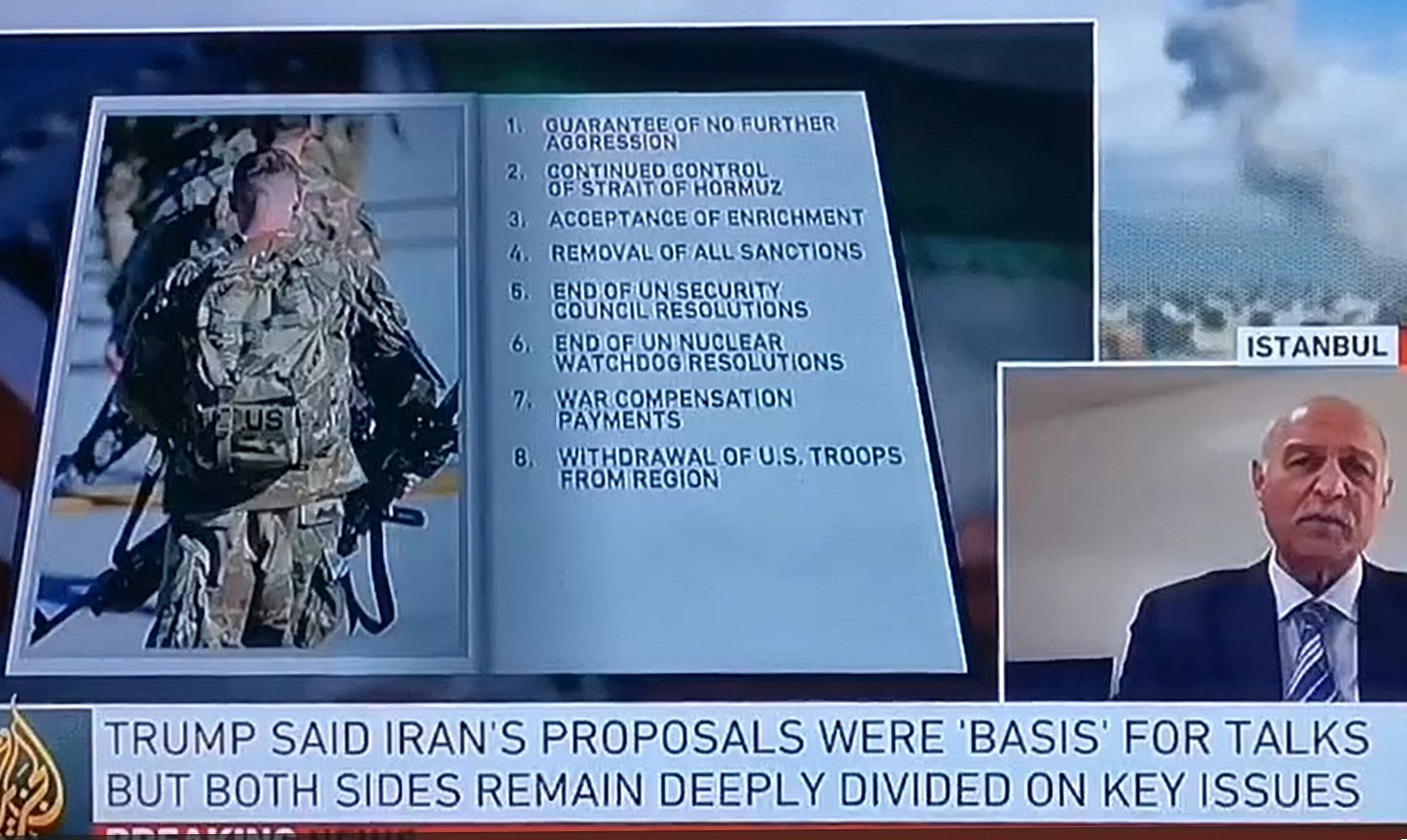
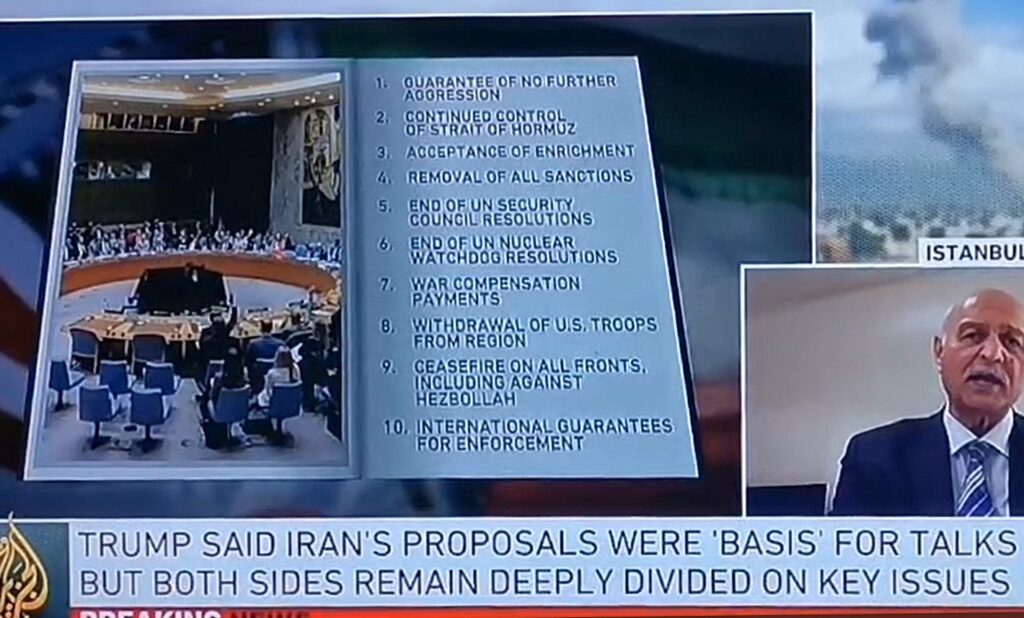
 But in fact they had no choice, as a Pakistani expert and commentator interviewed by Al Jazeera in advance of the Islamabad talks explained. He made some critical observations on the legitimacy of Iran's 'demands', as shown below in two parts; in the first he comments on the mandatory inclusion of Hezbollah and Lebanon in the agreement, along with its nuclear program directions, while in the second part below there is a useful visual presentation of the ten points in the plan.

 Most importantly he observes that "the Straits of Hormuz was not the reason for the war but the consequence of it" - and the consequence of Israel's illegal and unwarranted attack on Iran:
 Also putting the Iranian 'peace plan' - as it may be better described - in perspective was Alastair Crooke, who noted that:
"The 10-points, in effect, represent Iran’s pre-conditions to any move to a more substantive ceasefire".

 This makes it quite clear that Iran is in control of what now happens, whether its Western antagonists and enemies like it or not. If they don't like it and continue to launch attacks, then Iran's response will be blistering. If they don't like it but merely refuse to submit to Iran's conditions, particularly for passage through the Straits of Hormuz, then their economies and essential supplies will be severely threatened, and to the point where they may have to finally submit. Any attempt to force open the Straits by European and Western powers to whom they are currently closed, will only have negative consequences, resulting in a far greater threat to shipping that will make ships uninsurable and unprotectable.
 Such military action would also threaten the safe passage of ships from nations that are cooperating with Iran, including particularly China. It was reported that pressure from China, and specifically threats against 'Israel' was also a key factor in Trump's decision to cancel his blitzkrieg.

  It will take some time for this reality, of Iran's effective and unavoidable control over the strategic situation in the Persian Gulf - to sink in and be accepted by those currently pretending the conditions are 'totally unacceptable'. This includes Western commentators speaking on behalf of the US or Europe, as in this typical response from the ABC's leading journalist Laura Tingle speaking on the PM program:

 "- when you look at the ten-point plan, it includes a whole range of things which the US wasn't going to accept. It doesn't go to things like a limit on Iran's ballistic missiles, which the government in Washington has said that it wants to see done.  On the other hand, it includes a whole range of measures which would actually represent the most spectacular backward measures for the US in terms of the Iranian position. For example, it's talking about the US having to withdraw all of its bases in the Gulf. Now you can't believe that this is actually going to happen."

We'll just have to wait to see what happens, as the man said. And as an aide memoire, here are the 10 points we need to accept:
DM 10th April 2026