   "Burning one's bridges" was always considered unwise as a means of defence, as it narrowed the options of escape; nowadays "bombing other's bridges" is the preferred option for keeping the enemy at bay. But whether defensive or offensive, destroying such expensive and vital structures has only been justifiable for military objectives.. until now!

  One can think of many many occasions in the last few decades, both in West Asia and Eastern Europe where military forces have destroyed bridges - in almost all cases where NATO planes have bombed bridges in order to contain their opponents. These may have been government forces or militias, or so-called terrorist groups like 'ISIS'. It has been an effective strategy, but in almost all cases the destruction of such vital links across rivers or to islands has also seriously affected and alienated local populations.

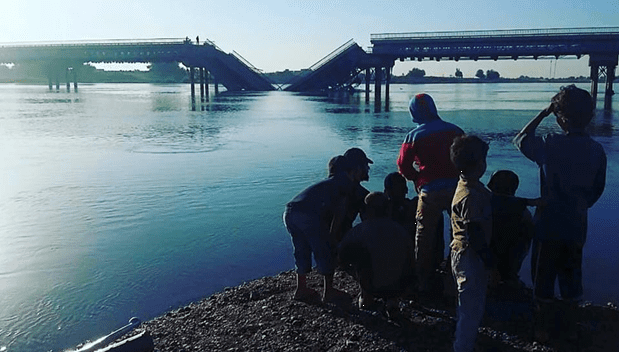
 It has also been the case that sometimes bridges have been bombed before the reason becomes clear - as for instance with the US bombing of bridges across the Euphrates in Eastern Syria in late 2016. That time, just after the liberation of Aleppo by the Syrian Arab Army, was apparently suitable for such vandalism; the old bridge across the Tigris in Mosul was also bombed then, as the US and local allies sought to control the movements of Iraqi resistance groups and the Syrian army - and take control of Syrian oil and gas resources in the 'jazeera' or island between the two rivers.
   The photo below from 2016 following the US bombing of a main bridge across the Euphrates at Deir Al Zour.
 Several years later bombing bridges became popular again, following Russia's intervention operation in Eastern Ukraine. Despite the many
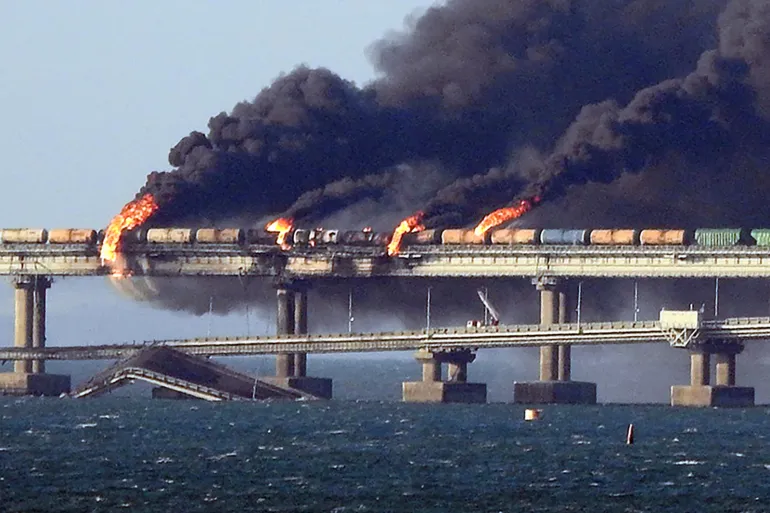
obstacles to military vehicles as well as troop advances, rivers still present the greatest challenge, while bridges are the easiest target. A whole series of bridges were destroyed by Ukrainian forces in Donbas to stop Russian advances, including the criminal destruction of the bridge and dam at Nova Kakhovka north of Kherson. But the most dramatic case of bridge bombing in Ukraine was the attack on the Kerch Straits bridge, built by Russia during the Azov's occupation of Donbas to bypass the land route to Crimea through Mariupol.  While that bombing was intended as a major psychological blow to Russia and to Vladimir Putin - who had personally inaugurated the road and rail bridge several years earlier, it was also deemed a legitimate military target, being used to transport equipment and fuel to bases in Crimea as well as civilian supplies.

   The first attack on the Crimean bridge ( there have been several since) was a coordinated assault using a suicide truck bomber and underwater explosives, and coordinated by MI6 with Ukrainian special forces, as here detailed by the Grayzone, which found evidence the attack was planned for six months beforehand.  To the disappointment of the Ukrainians, who had even issued postage stamps showing the destroyed bridge, damage to the train lines and one roadway was quickly repaired.
Which brings us to the 'bridge too far'. In contrast with the superficially similar attack on the Kerch straits bridge, the bombing of the motorway bridge in Karaj had no conceivable military objective, nor was it planned in advance as a strategic move. In fact the bridge was still evidently under construction, and not due for official opening till June this year.
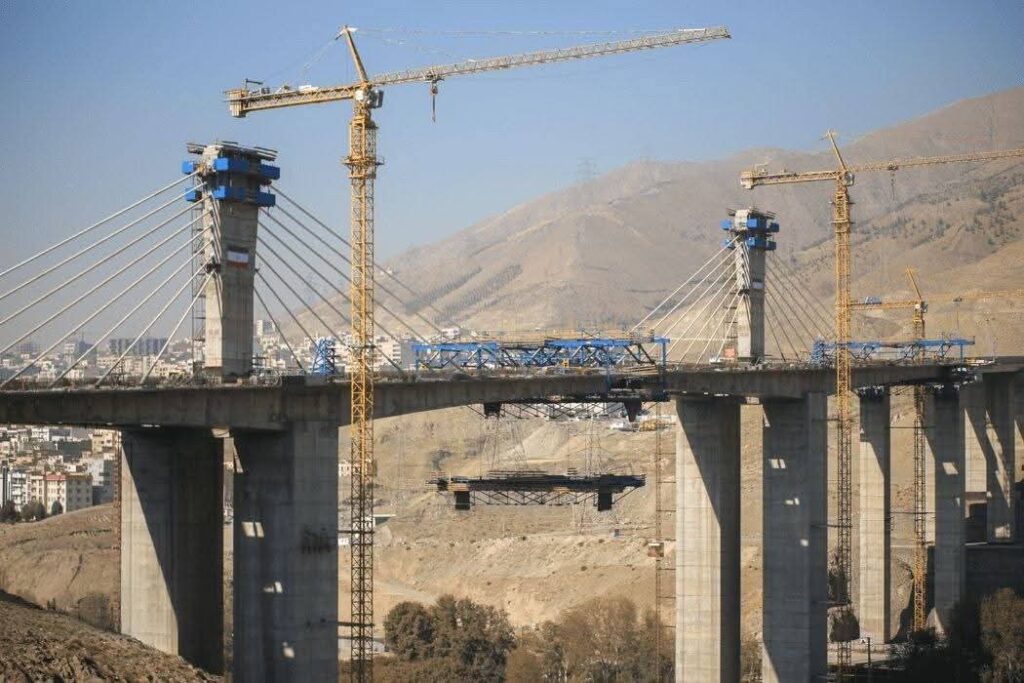
  The video below is taken from Al Jazeera's news bulletin from April 3rd, with a local reporter for AJ Arabic on the ground in Karaj. He makes it clear that the bridge had no military significance, yet the double strike was meant to destroy it as well as to kill and injure people around it. It was an undoubted war crime, as well as a strike against a purely civilian target. And as such, is guaranteed to produce a response in kind against the US-israeli collaborators in the Gulf from whence most strikes come.

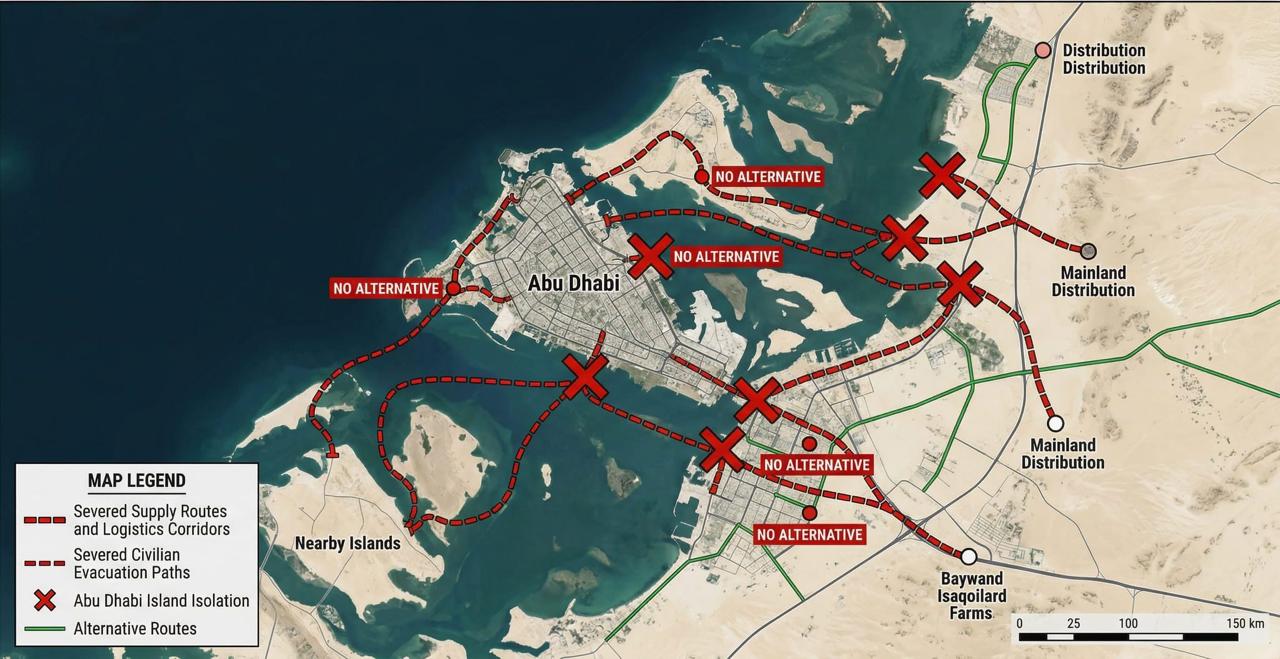
  Within hours the IRGC issued a map showing bridges around Abu Dhabi that could be targeted, highlighting the Emirate's extreme vulnerability to 'bridge attack', and justifying a variation on the saying "people who live in glass houses shouldn't throw stones" -

 - "People who live on islands shouldn't bomb bridges".

 Unlike the Karaj bridge - evidently constructed to improve traffic conditions around the city rather than as a necessary river crossing, bridges to Abu Dhabi city are its only link to the land, and given the current status of sea traffic in the Persian Gulf, that link is now a fundamental necessity for survival. As the leading illustration shows, there are eight such bridges, so we wait to see how many Iran chooses to attack, or whether other equally significant targets will do. Iran may well choose not to alienate the Gulf states further, in the hope they will sooner or later see the light and ask the US forces to leave.

And it will surely be sooner rather than later as the Hormuz 'choke-point' turns to a stranglehold on non-compliant states, and residents and investors watch as other countries do 'deals' with Iran in exchange for Persian gulf access.
DM 5th April 2026