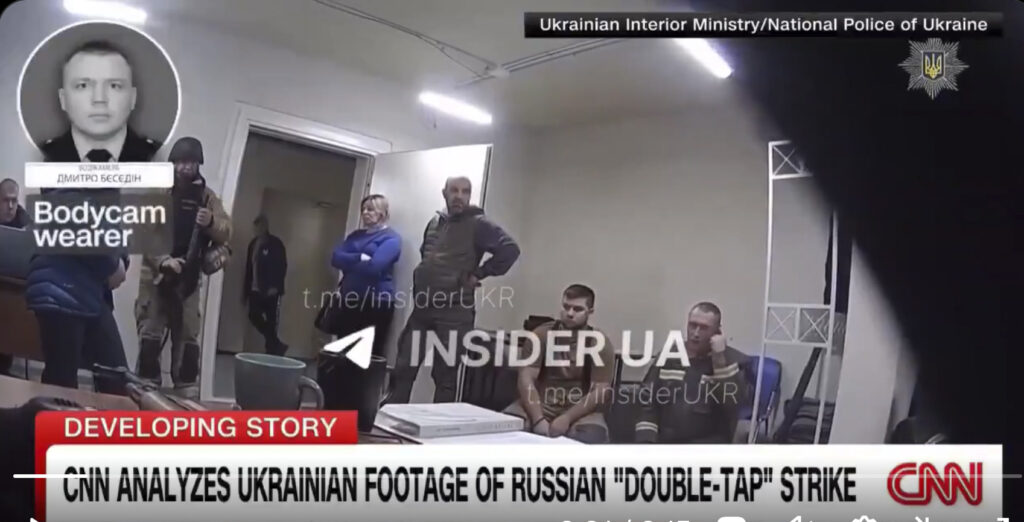
On November 2nd at 10.30 am, six Russian 3-tonne bombs hit and destroyed an underground bunker on the main route to the battle front in Komyshuvakha, SE of Zaporizhia. Half an hour earlier the site was hit by several smaller bombs by way of warning - this also leading to all the personnel retreating underground, where despite being 7 metres down all were killed. A week later the head-cam from one of the local police-militia was retrieved from the bunker, and a short clip of his last moments published by CNN, as shown below:
  The full video from Policeman Besedin's head-cam showing the minutes before retreating to the bunker is copied below, giving an idea about the people who were using it; 'civilians' doesn't quite suit the reality. In various reports from Ukrainian media and authorities, excuses are made for the presence of service personnel and police carrying weapons, in what they claim was a shelter addressing 'humanitarian needs'.

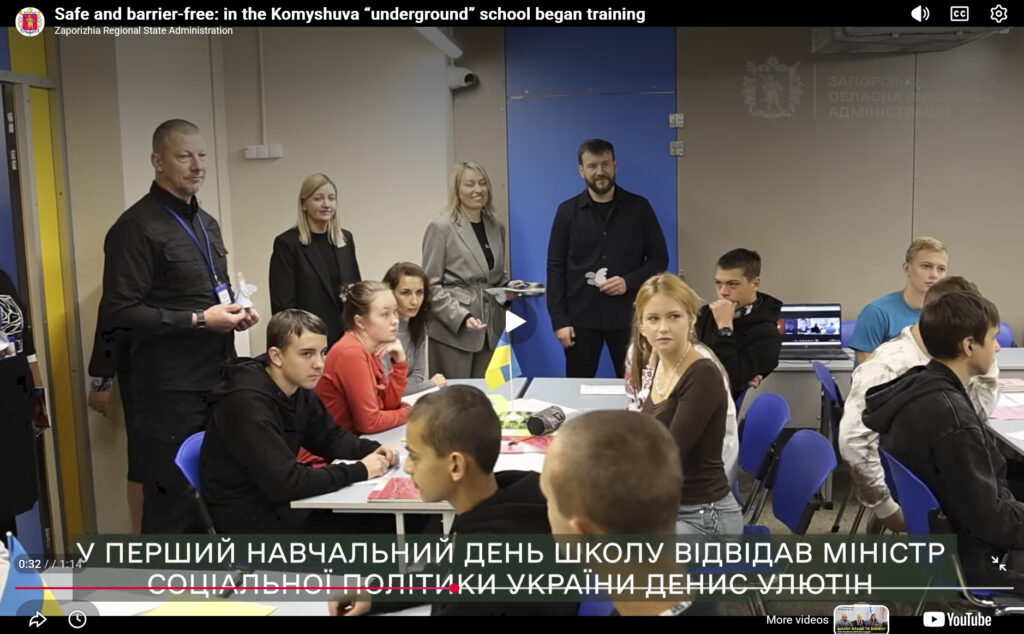
  While there is no evidence for this assertion, either in video of local residents gathering or of 'bread and medicines' being distributed, the bunker had been used as a school for a short time - as shown in the second photo below:
Before the blast, staff in the bunker.Opening of the underground school/shelter December 2025
  While the video published by CNN reveals the truth of Russia's statement that this was an electronic command post and military bunker, and the MoD evidently considered it worth such a massive amount of explosives, a different version of reality rapidly emerged from Kiev, and spread across the whole entirety of Western media - this was a deadly strike on a 'humanitarian aid distribution centre', and timed to coincide with a weekly delivery.

  This marks a new development in false flag propaganda, where a real attack by the enemy is used as if it had been staged, to justify new assaults - which in this case was another missile strike on a Russian refinery. Its timing was also propitious for Kiev, coming the day before the US election as well as 'peace talks' in Abu Dhabi and G7 meetings.

 Whether Russia chose to strike this target with any of that in mind seems unlikely - but it may well have seen intelligence on an imminent move by the AFU following a week's ceasefire after the Alyoshki humanitarian evacuation. It is however quite striking how Kiev seemed almost ready with the story that turned a significant strategic blow into a propaganda opportunity, as Zelensky wasted no time in spreading the story of 'a vile terrorist attack' amongst his European sponsors and their puppet media.

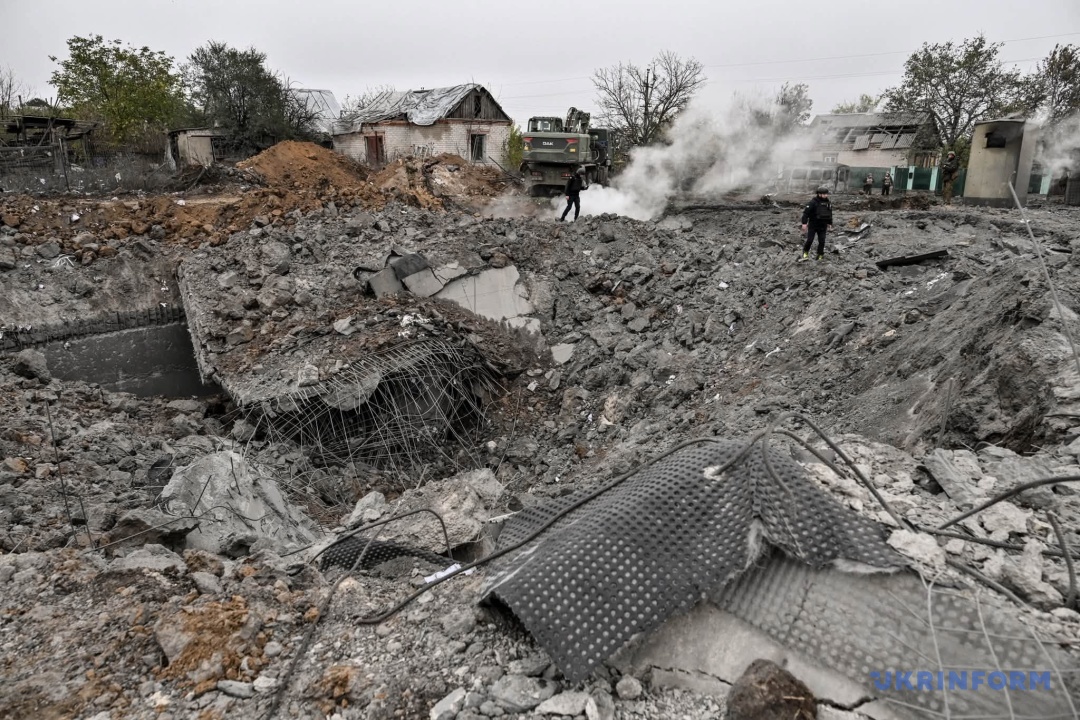
 So pervasive has the chosen Kiev narrative been, along with corresponding outrage against Russia, that it has been difficult to discover the truth about what was hit. The first reports and videos only briefly showed the massive crater with a give away slab of reinforced concrete within it, which can be seen clearly in my leading photo. The site was variously described as a disused school or shelter, both of which was true - except the original school had been destroyed in July 2023 and the 'shelter' was a deep underground complex built with EU funding in 2024-5.

  More details of the place are in this BBC report, including some giveaways :-

Russia's defense ministry said the attack had targeted Ukrainian military units and killed 25 servicemen.
However, there was no credible evidence that the site was being used by the Ukrainian military and there were no major military or industrial facilities in the settlement of Komyshuvakha, reports BBC News Russian defence correspondent Ilya Abishev.

The village is to the south-east of the city of Zaporizhzhia, which has come under constant Russian bombardment.
According to Abishev, Komyshuvakha is of high military importance as part of Ukraine's defensive and transport network on the approaches to the regional capital.

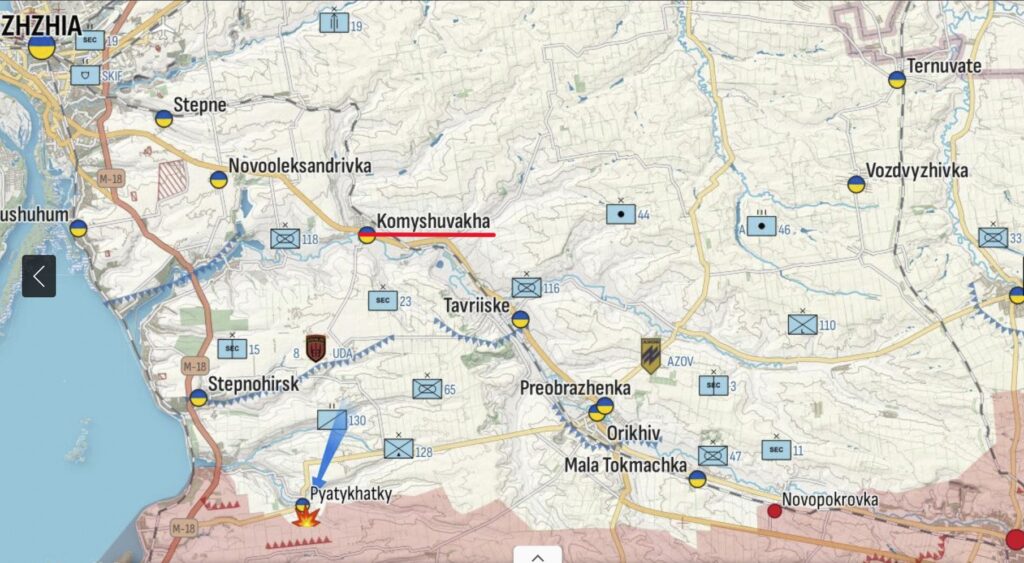
 The settlement itself may not have 'major military facilities', but it lies on the main road to frontline towns further south as well as next to a main rail line. Consequently Komyshuvakha has come under repeated attacks, including the strike that destroyed much of the school building which stood on the site back in July 2023.  A map of the area shown below dates from June 2023, but this front line has remained fairly static since then as the main battles are fought out further east in Donetsk. Recent attention to the situation further down the Dnieper, in Kherson and around the Zaporizhia NPP may indicate a shift in focus of Russia's campaign.
CNN video analysis of Komyshuva bunker bombing 9th November 2026
Wikipedia provides much useful background information, including links to Ukrainian sources such as this and this. From these we learn how the bunker came to be constructed as a well protected space capable of being used as a school and shelter, but obviously with military function if necessary - given the strategic location of Komyshuvakha. EU funding was also likely made available with this in mind, given the EU commitment to Ukraine's war against Russia.
To quote:
Komyshuvakha is a rural settlement located within Zaporizhzhia Raion. It is located about 30 km from Zaporizhzhia and is on an important highway that connects the positions of the Ukrainian Army, which uses it for traffic, supplies, and evacuation.[7] Komyshuvakha is also located near the sectors of Orikhiv and Stepnohirsk on the front, which are both important cities to capture on the way to Zaporizhzhia.[7]As such, is considered a frontline settlement, and as such has been constantly hit by KAB bombs and FPV drones, although according to locals, the shelling has ramped up since 2026.[8] There were at least four prior strikes on the village before 2 November: one on 22 January, which killed one and injured ten, one on 15 June, which injured four, one in August, which destroyed residential buildings, and one on 28 October.[7] This has led to an exodus of many local residents leaving and others also being evacuated.
While remembering that this was NOT a false flag attack by Kiev, it must be noted that there have been multiple reports and updates on the bombing of the shelter and retrieval of bodies, both in written and video reports on mainstream Western media, and there is no doubt that this desired but completely false narrative will be adopted as the historic truth. This is in comparison with the true and notorious false flag attacks in Bucha and Mariupol, which were both atrocities committed by Ukrainian Nationalists with MI6/CIA assistance, and used to frame Russia in the Western media.
For Western audiences however, this distinction is mostly irrelevant. With the overwhelming success of the Bucha story as a symbol of supposed Russian brutality, all subsequent stories are simply added to the pile or else ignored and quickly forgotten. This was the case with the 'missile strike on a market' in Kostantinyvka, which was a false flag attack by the AFU that backfired when the NYT sent reporters there, and when video emerged showing the missile coming from the North and Ukrainian controlled territory. That was the last we heard of it - as the NYT has immediate credibility; when a similar attack on a Kramatorsk railway station was exposed by Russia as a Ukrainian missile coming from AFU territory, the story persisted, and is still added to the ledger. (I include this case in the above article and analysis)
As I conclude this article however, the question of the Komyshuvakha command post rapidly fades into history; yesterday's destruction of the beautiful Kersh strait bridge to Crimea was apparently well advanced in the planning before Russia's bunker-busting strike. It must be a crime with massive consequences, given the nonchalance of media reports and the visible celebration by Western leaders, some of whom are so up themselves as to criticise one voice of caution from the US; Credit where credit is due to Elbridge Colby, US under-secretary of state, for noting that attacks on Russian civilian assets would likely have the effect of strengthening Russian solidarity and Kremlin resolve. Any talk of 'peace' or agreement is now finished, as Russia decides which bridges to destroy, inside or outside Ukraine's borders.
While the Western narrative remains that Crimea was 'annexed' and is 'occupied territory', it has now been part of Russia for 12 years, and chose to annex itself in an overwhelming majority referendum only weeks after the Kiev coup. In terms of acceptable international law, it was the violent takeover of Kiev by unelected and selected proxies that set the example for what might be considered legitimate defensive action by Crimea; the desire to separate from Kiev came from Crimea and was accepted by the Kremlin, and took place without military force.
But that will be the subject for another article..