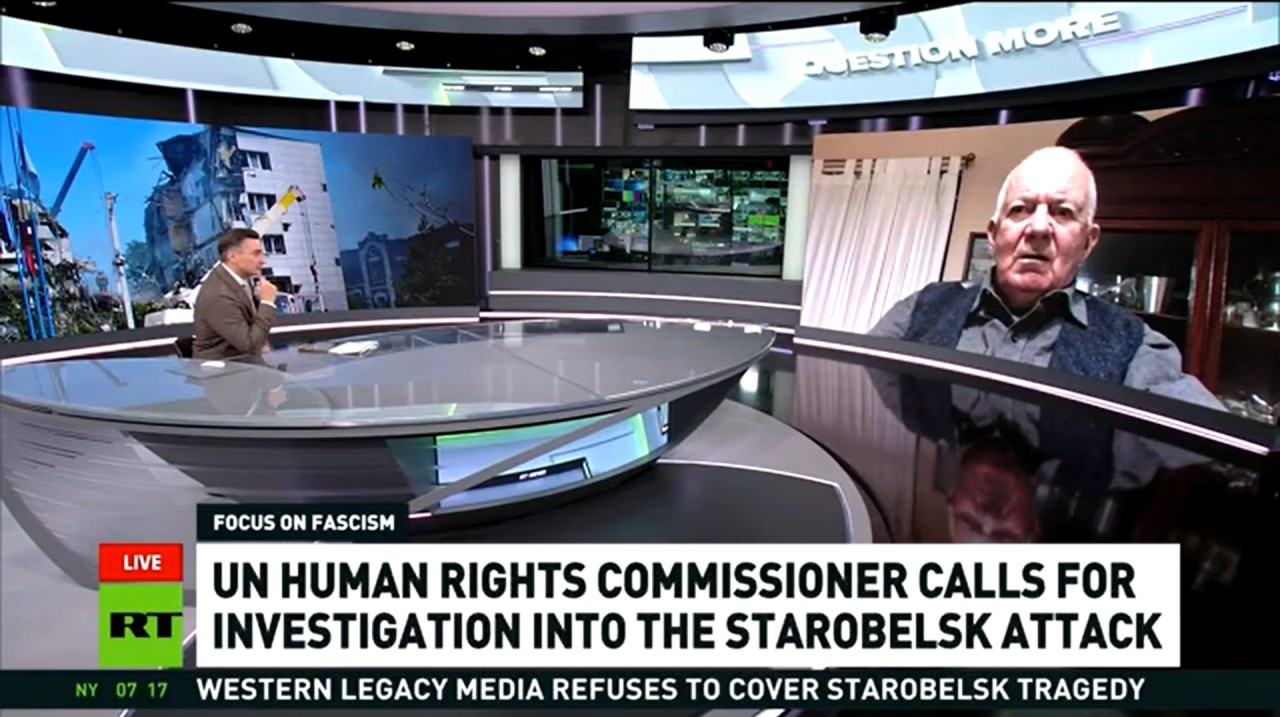
  In an act of calculated and callous bastardry on the night of May 21st, Ukrainian soldiers sent 16 long distance drones in three waves towards the central city of Starobelsk in the Lugansk Peoples Republic, hitting and destroying a student dormitory of the Lugansk Professional College, where over 80 teenagers were sleeping. The successive strikes collapsed the three upper stories of the five storey building, killing 21 and seriously injuring the remainder.

  While the Ukrainian regime claimed it had targeted a Russian military drone unit, even its allied media who visited the site found no evidence of such a place or activity. The Russian ministry of foreign affairs didn't hesitate to identify the strike as an act of terrorism and a war crime, nor accept that the 'triple-tap' strike could have been an error, and vowed a significant response. (NB - a week later Kiev now denies 'responsibility' for the strike - as reported by the msm.)

  While the Kremlin had been considering a serious strike on Kiev's government and military command centres for some time, the heinous attack on young student teachers provided the pretext as well as the public support for what soon followed - Russia's massive strike on Kiev's central public buildings alongside a special warning strike on a military centre and airbase south of Kiev with a hypersonic Oreshnik missile.

 While the motive for Kiev's attack on Lugansk's young teachers may have been a provocation intended to draw Russia into a fight, and Zelensky immediately vowed a response, the outrage amongst Western leaders and their media over Russia's missile strikes - which killed four civilians - drowned out any condemnation of Kiev's murderous attack. Some Western media described the crime merely as 'an incident'. None thought to accuse Kiev of intentionally targeting children sleeping in their beds.

  The reaction to these events in Australia was in line with its European allies, with Foreign Minister Penny Wong accusing Russia of disregard for civilian lives and international law, while dismissing any suggestion Russia was responding to Kiev's increasingly flagrant violations of Russian territory. Even as the atrocity committed in Starobelsk gathers more attention, and following a UNSC meeting called by Russia, Australian leaders and media have nothing to say. Fortunately RT sought to fill in the gap, interviewing former Ambassador Tony Kevin on May 28th to talk about this media failure.

   RT provided a link to a section of the interview and discussion on that failure, which is posted on RT's telegram channel here; I have copied the segment in part 2 below, along with the rest of the interview recorded live. The quality is a little mixed - but worth following for the important content, and because such discussion is so pitifully absent from the public sphere. Some further comment follows.
 For more perspective on the Starobelsk attack and aftermath, there is a good video made of the special journalists' visit to the site, following an invitation from the MFA. Russia's new human rights commissioner Yana Lantratova led the group there and spoke forcefully about the depths of the crime. Some countries refused to send journalists or made excuses - as was the case with CNN whose reporter Nick Paton Walsh they claimed to be on vacation. This was not seen as a credible excuse given he had illegally entered Russia during the Kursk invasion, and was even suspected of accompanying the drone unit that targeted the school dormitory.

 (It should also be noted that the territory of Lugansk province is now part of the Russian Federation, following its approval by referendum of the population to join, alongside Donetsk. Western countries and their media continue to refer to it as 'Russian occupied', and to the Lugansk governor (also accompanying the journalists here) as 'Russian-appointed'. By the time Russia liberated Lugansk from the oppression of Kiev's forces, its citizens had already endured eight years of partial occupation and the constant threat of attacks.)
Neither was there any mention of Australia, though ABC correspondent  Katherine Diss had also accompanied Ukrainian forces entering Kursk. These two journalists are of course threatened with arrest if they enter Russia illegally again, and continue to put out misleading and false reports from Ukraine.
 Australian media continue to cite "Russia's attack on the Kiev Children's Hospital" in July 2024, despite it not killing any children and being hit by a Ukrainian self-defence missile, not a Russian cruise missile as claimed. The involvement of Bellingcat confirmed the fraud, but the campaign based on the lies was incredible.

  (Following extensive analysis of the area around the children's hospital, I concluded not simply that it was hit by a Ukrainian missile, but that it was in fact a false flag attack, cleverly launched under the cover of Russian missile strikes on Kiev. This article and site inflates the strike and casualties out of all proportion, making one wonder whether the missile was intended to cause more deaths by hitting the hospital directly.)

As RT asks in the interview - what likelihood is there of a UN commission of inquiry actually taking place and making meaningful and effective recommendations? As with so many other cases where such investigations have actually taken place, it may be assumed that the UN remit would not allow for Ukraine to be accused and charged with committing an atrocity against innocent and defenceless civilians - leave alone for Kiev to be revealed to have targeted them intentionally, as was so clearly the case.  Decent journalists and people of good intent must be satisfied with verifying to their own satisfaction what actually took place - as is demonstrated by this video story from RT, where reporter Murad Gazdiev accompanies Yana Lantratova through the partly ruined dormitory building.

  It might be noted - just looking at the above X account - that there is a lot of push back from Kiev's squadrons of Russia haters and propagandists, who claim Starobelsk was a 'military training college'. This it may well also have been, given that Russia has to fight a hi-tech drone war against Ukrainian drone technology being backed by a dozen European nations and the UK. But the University had numbers of departments, and the dormitory was home to 80 mostly female teachers in training, who would have been at schools in Starobelsk and around since February 2022, when the town was liberated from Kiev's grip. Before that, most of their education would have been under Ukrainian control, with the Russian language mostly prohibited, so these current students may have come from further south and Russian-speaking areas.

  For those eight years previously Starobelsk had been under Kiev's control, and the Ukrainian section of Lugansk University had been moved there following the setting up of the Lugansk Democratic Republic in 2015. Starobelsk had long been a majority Ukrainian speaking city, while during WW2 had housed a prison, from which 3,800 Polish prisoners were transported to their deaths in Katyn. This history probably explains largely why Kiev chose to target a town that few had heard of before to commit this crime of 'revenge' against the local community.
DM May 29th 2026